Introduction
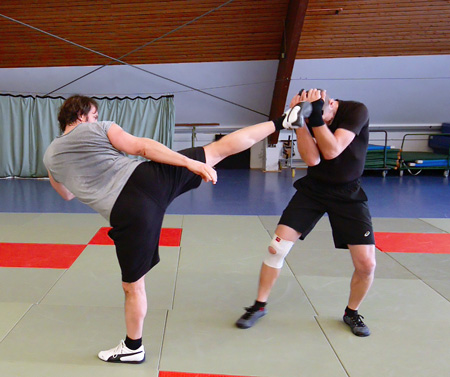
Here’s a question for Core JKD: Why would you train high kicks or kicks that seem flashy when you are about street defense and life-and-death survival?
My reply is very simple: because I also train people who wish to go into competition where the rules and the environment allow for a flashier grade of technique that won’t get you killed.
But let’s go beyond that for a second and ask another question: Why would you train to use a high kick to defend yourself in life-and-death encounters?
Considerations for High Kicks in Self-Defense
First and foremost, our methodology and mentality is not to choose high kicks as a method of your best chance of success in a confrontation with single or multiple opponents with or without weapons.
As a matter of physics, generally, high kicks require more muscle involvement, and that means more energy resources used for a particular effort. This puts them lower down on the list of tools to use simply because, when engaged in a confrontation against single and multiple opponents, resources are at a premium.
High kicks must also have the following ingrained, reflexive attributes:
- They require an excellent base, not just to execute the kick accurately but also to be able to deal with the rebound effect from hitting a solid object that may have its own momentum and path.
- They require the ability to flow to successive close-range and long-range combinations that may include tools from boxing, trapping, and weapons ranges.
- They must reflexively respond and adapt to the changes in environment, as well as the forces of bodies in motion.
Where to Use High Kicks in Life-and-Death Situations
“Where would you use a high kick in a life-and-death situation?”
The problem with most people’s understanding and viewpoint is that fights occur on solid ground against a single opponent who only wants to use their fists or kicks. Most people, as in the general public, hold this view.
Anyone who has trained for a serious length of time or lived in environments where the threat to life is a frequent occurrence understands that fights can occur at any time and in almost any place.
Let’s take a look at the high kick again. High kicks don’t just come in the flavor of Tae Kwon Do kicks or the traditional karate kicks seen in 1970s movies.
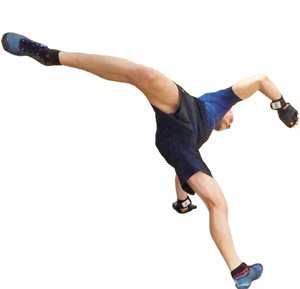
Other arts can employ kicks that seem to come out of nowhere. Take Capoeira, for example; their Meia Lua de Compasso, in particular, can be used out of a feint, fall, or diversion. The success rate for this particular kick is pretty high when the person using it is skilled in the right areas.
The “right areas” here include: reading another person’s timing accurately; interpreting visual field information to directly translate it to a reflexive response; and having good control over your own musculature, balance, and small motor control.
In Core JKD, we do a slightly modified version of the Meia Lua de Compasso that is part of a kicking and boxing combination. Anyone who has been hit in the head by this particular kick in training or sparring—even lightly—understands the need to sit out for a time, if not the next few days, while they recover.
The Environment and Situation
Because we don’t always get the luxury of picking the environment—or situation—in which we get attacked, here are a few examples where high kicks can actually be effective:
- Uneven terrain: Anyone who has trained knife fighting, or sparred on a hill that is covered in wet leaves, understands the value of the high ground intimately. That same understanding covers most forms of physical attack on greatly uneven terrain. So, a kick to the head from a higher elevation isn’t technically a high kick. It is a way to silence any of your training partners’ ridicule because you can’t kick higher than your waist. Uneven terrain in this case is an equalizer and a way to maximize the efficiency of contractile muscle involvement without losing your balance as easily.
- As a method of surprise: In Core JKD, we tend to favor kicks that have their origins in Muay Thai, Savate, and Capoeira. The kicks alone mean nothing if you don't know how and when to use them—specifically when. It is entirely possible to execute a Muay Thai teep, or a Savate feute to a person's jaw or throat from the boxing range while you trap or otherwise deflect or bind their attacking tools.
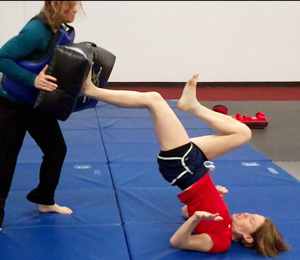
- From a fallen position: Not all engagements occur on your feet. If you don't know how to execute a kick from your back, or as you are rotating or otherwise transitioning to stand from a downed position, you're limiting yourself and your chances of survival in a life-threatening encounter. Kicks delivered from a fallen position are, in essence, a high kick.
Additional Benefits of High Kick Training
Why else would you train high kicks? High kick training has several other benefits:
- Conditioning: There’s nothing like using large muscle groups like the legs to train your endurance. Think cardio-strength training. It gets the blood moving, raising your heart rate and metabolism quickly.
- Stimulating support musculature and balance recovery: This attribute training is essential whether you’re training with knives or in the clinch range against multiple opponents. Ancillary muscle group engagement, strength, and fine motor control is increased greatly in the legs when you train kicks with a dynamic base that flows into other combinations and other ranges. This gives you a strong, dynamic support structure that can help even on the ground when working to get off your back.
- Increasing fast twitch-muscle fibers: Kick training in general forces us to close ranges quickly and to evade just as quickly, helping you intercept attacks or to evade/escape.
Final Note
Kick training doesn’t necessarily have to be above the waist. Even low kicking with dynamic footwork will give you a better support structure when using your upper body tools—in any range.
As I stated earlier, Core JKD does not use them as a high-percentile choice when engaging in a life and death scenario.
But, as a wise person once said:
—Ming